The Week is presented by

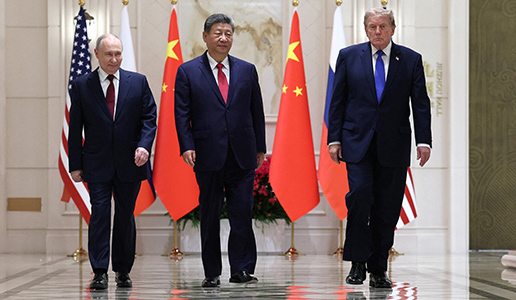
The Tree Amigos Summit
◼ We swear, it wasn’t our redesigned website that brought down email and the airlines.
◼ In an unprecedented trilateral summit in China this week, Xi Jinping and Vladimir Putin sat down with President Donald Trump. Ahead of the summit, Trump set no metrics for observers to judge its success. The summit cannot be said to have failed: It was not designed to achieve anything, and it didn’t. Of course, the president reportedly went into the diplomatic event of the year with some goals in mind. He reportedly sought commitments to nuclear disarmament from his Russian and Chinese counterparts, neither of whom had an incentive to agree to such limits. If Trump persuaded them to assist America’s efforts to isolate Iran economically, he has kept it a closely guarded secret. Putin sought to make the summit all about his war on Ukraine, but the Russian autocrat secured no meaningful promises on that front from Washington or Beijing. Only China, it seems, got what it wanted from the summit, which took place on its soil. The event allowed Xi to pretend to arbitrate the conflicts in which his great-power competitors are embroiled. The affair was not entirely unproductive, of course. It produced many joint statements of principle, which essentially state that all parties have agreed to keep talking.
◼ CNN reported that U.S. intelligence services have detected Iranian plans to detonate a radioactive “dirty bomb” in Washington, D.C., to assassinate senior U.S. officials. Meanwhile, Trump has signaled that he is contemplating renewed military action in the Gulf. The least bad option may be to continue the current policy by maintaining a naval blockade against Iran and escorting ships through the Strait of Hormuz. While maintaining that pressure, the U.S. should also look for ways to actively support the Iranian opposition, something Trump implicitly promised in January when he told Iranian protesters that “help is on its way.” We obviously cannot bank on the Iranian regime’s falling or moderating any time soon. But it is hard to see what strategic goal can be accomplished through another weeks-long air campaign. The immediate diplomatic prospects are also dim. If any eventual agreements are to be reached with Iran, they must meet two tests: First, do no harm, and second, trade nothing for any promises of future good conduct by the Iranians.
◼ Last Friday, a telecommunications failure forced the Federal Aviation Administration to order a rare nationwide ground stop for over four hours, canceling more than 20,000 U.S. flights. The stop was apparently caused by a faulty upgrade to the agency’s air-traffic-control infrastructure. The aging copper-wire system, which is slowly being replaced, should have been decommissioned years ago in favor of newer technology. The FAA claims it needs tens of billions in new funding to finish the job, but what it truly requires is wholesale institutional reform. Canada’s privatized counterpart accomplished most of the same transition in just 18 months, while the FAA’s efforts have dragged on for a quarter century. Congress ought to emulate this worthwhile Canadian initiative and spin the agency off into an independent organization funded by direct user fees rather than taxes. Until air traffic control is accountable to the flyers it serves, few improvements will be made.
◼ The FAA isn’t the only institution suffering from technical difficulties. Within the past week, Microsoft’s Outlook service, JPMorgan Chase, United Airlines, and, reportedly, the National Security Agency’s secure communications network have experienced outages. The federal government has denied theories of coordinated cyberattacks. A more likely connection among the incidents is that many organizations are installing software patches to close cybersecurity gaps exposed by AI-powered security testing. As bugs are fixed, the reliability of these systems should actually improve in the long run. There may also be a frequency illusion as regularly occurring outages are depicted as anomalies by national news outlets—akin to when people start noticing small, prop plane crashes after a big, newsworthy airliner crash. Whatever is going on, we hope that this newsletter reaches you safely.
◼ There is intramural argument on the right over how to interpret the GOP’s historic loss in the midterm elections. The most elemental need is for a better GOP—one that is not beholden to the will of one man, doesn’t tolerate corruption, insists on strict adherence to the rule of law, encourages Congress to take up its allotted role in our constitutional system, rewards policy entrepreneurship on the part of officeholders, and focuses on results rather than performative provocations. Unless the party renews itself, it risks subsequent devastating votes of no confidence from the American public. The GOP could do much worse than look to the states, where Republican governors and legislators have cut taxes, restrained spending, pared back regulations, protected unborn children, and pursued reforms of schooling and housing. At the national level, the GOP requires a cost-of-living agenda that addresses high costs in health care and education. But arriving at a coherent agenda will require a seriousness of purpose and substantive focus that have been lacking for years now. As Lincoln said, it is a time to think anew and act anew. The GOP desperately needs something fresh and different, with ideas and policies designed to meet the challenges of the day.
◼ Democrats have been railing against the Electoral College since 2000, and their anger grew when Hillary Clinton lost the 2016 presidential election while winning the popular vote. Their frustration amounted to empty rhetoric—until now. Eighteen blue states and the District of Columbia entered a National Popular Vote Compact to give their electors to the winner of the national popular vote instead of the winner of their state. But that compact was conditioned on states worth 270 electors, a majority of the Electoral College, joining it. This fall, Democrats gained unified control of enough states—one of which (Pennsylvania) has a governor with 2028 presidential aspirations—to clear that bar. Will they try? The 2024 election should stand as a reminder to Democrats that Republicans can, at times, win the most votes. Not so long ago, the Rust Belt “Blue Wall” was an asset to Barack Obama. The compact is a terrible idea for many reasons, from the incentive it provides deep-blue states to drive up Democratic margins with loose rules on election integrity, to the varying speeds and deadlines for states to count votes, to the terrifying prospect of a nationwide recount. It would also force smaller states to sign away their own voices. Moreover, there are legal problems with an end around for the constitutional process, including the fact that interstate compacts must be approved by Congress. Democrats should acquaint themselves with Chesterton’s fence.
◼ Michigan Senator-elect Abdul El-Sayed insists that he is not a democratic socialist. “I’m too much of a scientist to actually believe in any sort of ideology,” he told CBS News correspondent Ross Douthat. But he endorses the dismantling of the “currently existing State of Israel” and sees Jerusalem as a national security threat on par with anything on offer from Tehran. El-Sayed emerged from the midterm elections with his radicalism intact, and he wants to popularize that model. He already has takers. In a recent interview, Fox News’ Martha MacCallum repeatedly asked Ahmed Moor, a Democrat seeking to unseat Pennsylvania Senator John Fetterman in 2028, whether he supports Hamas. Moor repeatedly refused to answer. Moor is only the first of many El-Sayed imitators who hope to follow his lead and drag the Democratic Party toward his Islamist-curious socialism.
◼ The city of Los Angeles has joined New York City in electing as mayor a young, hip Democratic Socialist candidate, Nithya Raman, over an establishmentarian Democratic dinosaur. It’s not hard to see what happened here. L.A. Mayor Karen Bass may have been an old, boring apparatchik, but she was also famously incompetent: The recovery from the January 2025 Palisades Fire has been so slow that it seems almost deliberate. Raman promises to appoint a “recovery czar” and a “nightlife czar”; renters will be protected by a new “office of tenant protections”; her campaign slogan is “a city that works.” But it’s hard to see how more DSA-style government social services and less law and order are what ailing cities such as New York and L.A. need.
◼ Following months of negotiations with, among others, New York City’s police commissioner Jessica Tisch, Mayor Zohran Mamdani announced that he will fulfill his campaign promise to disband the NYPD’s Strategic Response Group (SRG). The unit was once tasked with responding to major crimes and mass public disturbances. Most of its officers will be redeployed to the department’s Counterterrorism Bureau. But whom will the mayor call when, for example, protests devolve into riotous and even insurrectionary violence? Mamdani’s plan is to establish a civilian force that has no uniforms, no weapons, and no power of arrest. “A First Amendment support team within the department, called FAST, will also engage in dialogue and deescalation at protests as we build out the new civilian division,” he promised. Indeed, according to Mamdani’s ally, City Councilman Chi Ossé, police will no longer deploy nonlethal ordnance against rioters or even engage in “kettling”—the practice of containing a mob so that its violent agitators cannot commit crimes and then dissolve into the urban landscape. What Mamdani and his socialist allies refuse to accept is that violent rioters aren’t interested in progressive social change nearly as much as in, well, violence. New Yorkers elected a mayor who was on the wrong side of the barricades during the long, hot summer of 2020. The city will get what it voted for.
◼ Chicago’s chief financial officer has abruptly resigned from her position. Ashlee Gabrysch’s resignation was startling in both its suddenness—she was only three months into the job—and its bluntness: “To continue in this role would be to compromise my integrity and professional obligations,” she wrote. But her resignation was in no way unpredictable, because Gabrysch is the third person appointed to the CFO position by Mayor Brandon Johnson to quit this year alone. Johnson has already become infamous in the city for his bumbling haplessness and lack of communication skills, but this level of dysfunction, as well as the carefully chosen wording of Gabrysch’s resignation letter, suggests that something is desperately rotten in the state of Chicago’s public finances. Johnson already faced an “unexpected” budget deficit of nearly a billion dollars last year—and it’s been downhill from there. Chicagoland isn’t exactly famous for its fiscal prudence, but this takes the deep-dish pie.
◼ Among the many dismal effects of government overreach during the Covid-19 pandemic was the boost that it gave to vaccine skepticism, which had long been encouraged by figures such as Robert F. Kennedy Jr. The result was a decline in the percentage of young children receiving the two-dose MMR vaccine that protects against measles, mumps, and rubella. In the years prior to Covid, the percentage of kindergartners getting the shots had been declining but remained just above 95 percent, the number typically regarded as the threshold to create herd immunity. By the 2025–26 school year, that number had fallen to 92.4 percent (and in many states it was lower still). In 2000, after years of effort, measles was deemed to be “eliminated” in the U.S., an achievement that has now been reversed. The CDC has issued a statement reiterating its support for the MMR vaccine and is backing up its words with dollars. As Health and Human Services secretary, RFK Jr. has said that he believes that the vaccine prevents measles, but it’s hard to avoid noticing a certain hesitancy on his part based on his history of baselessly questioning the vaccine. Measles can kill or cripple. If enough adults act with that knowledge, it can be stopped.
◼ Anthropic, developer of the AI model Claude, broke the record for the largest initial public offering in history by raising $81.3 billion—surpassing the $75 billion raised by SpaceX earlier this year—and establishing a total value of $1.5 trillion. Its competitor, OpenAI, the maker of ChatGPT, likely won’t be far behind. Retail investors should celebrate the opportunity to buy into the burgeoning AI industry at this early stage. Progressives keep demanding that developers share the wealth they have generated, ideally by forking over large equity stakes to the federal government. But why make Washington the middleman when Americans can own a piece of Anthropic themselves? Past investors can cash out by selling their shares to willing buyers, and new stockholders can profit from everything the company does thereafter. It looks like the future really is for everyone.
◼ The acclaimed French author Michel Houellebecq once again faces the ire of French authorities. Houellebecq first attracted his government’s scorn in 2002, after he described Islam as “dangerous” and “the dumbest religion” in an interview. He was sued and tried for “hate speech” but ultimately acquitted on the grounds of free expression. Now, he has been indicted for remarks he made in a 2022 interview: “When entire territories come under Islamist control, I think acts of resistance will take place,” he said. “There will be attacks and shootings in mosques, in cafés frequented by Muslims, in short, Bataclans in reverse.” Houellebecq’s comments were merely a prediction of a grim potential future, not an endorsement of any such violence against Muslims. But that has not prevented the French state from placing him under investigation. If the case goes to trial and he is convicted, Houellebecq could be imprisoned. This is a brazen attempt at censorship that should be dismissed on its face. And yet the global left, which is typically all too eager to accuse the right of seeking to silence authors and ban books, has fallen conspicuously silent.
◼ William Nordhaus was an economist unafraid of findings that trod on politics, no matter whose argument he aided. From his ivory tower at Yale, he dedicated much of his scholarship to the economics of climate change, trying to devise a market where one did not exist. Nordhaus pioneered the idea of pricing emissions through a global carbon tax based on the “social cost” of carbon, earning progressive plaudits. Yet he simultaneously discredited a net-zero policy, estimating the optimal emissions level to be high given the enormous costs of reduction. For this work, Nordhaus won the Nobel Prize. He also vindicated conservatives by calculating that wealthy entrepreneurs capture just 2.2 percent of the value they create through technological advancements, while the rest flows to consumers and the broader public. A true social scientist, he was contested and respected by both sides. Dead at 85. R.I.P.
The next The Week newsletter will appear on Friday, December 4, 2026.
A message from Donors Trust

The Donor-Advised Fund That Shares Your Values
If you support charitable causes through a community foundation or donor-advised fund, your donor intent could be at risk. Other providers have denied grant requests to conservative charities and redirected donor dollars to left-wing causes. DonorsTrust is different.
From National Review Institute
Keep National Review Independent
Make a donation to support the conservative commentary, independent reporting, and sharp analysis that have defined National Review for more than 70 years.

DOWNLOAD THE APP


19 West 44th Street, Ste. 1701, New York, NY 10036
Preferences · Unsubscribe · Privacy · Terms
You're receiving this because you signed up for The Week.
© 2026 National Review